
About Us
Our History
We have been offering 100% refundable insurance since 1794 — even before Baltimore was officially recognized as a city. Instead of annual premiums, our policyholders make a deposit, which is promptly returned when coverage ends. With the average customer relationship lasting more than two decades, our company has remained strong, even through events like the Great Baltimore Fire, the Great Depression, the 1968 Baltimore Riot, and the 2008 financial crisis. Explore the timeline below for a look into our past.
1752
Philadelphia Contributionship Founded
Philadelphia Contributionship, the oldest insurance company still in existence in the United States was founded by Benjamin Franklin and fellow firefighters.
July 4, 1776
Declaration of Independence Adopted
The Second Continental Congress met in Philadelphia and approved the final draft of the Declaration of Independence, thereby severing the 13 American Colonies’ political connections to Great Britain. The document was actually signed on August 2, 1776 by all 56 delegates grouped by state from north to south, with the exception of the President of the Continental Congress, John Hancock.
Feb 17, 1794
Baltimore Equitable Society for Insuring Houses from Loss by Fire was Founded
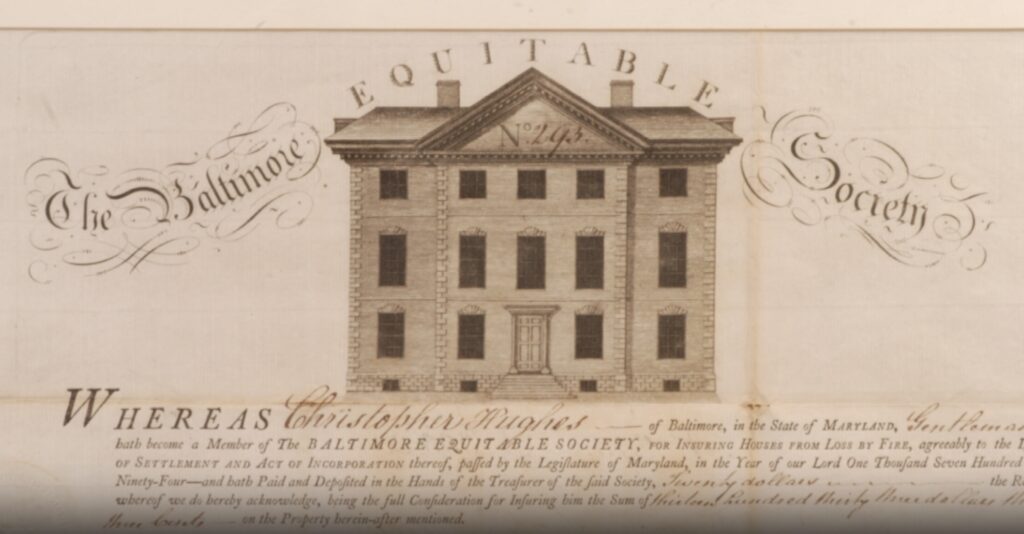
On February 17, 1794, at a meeting held at John Stark’s (also spelled Starck) Tavern, the constitution of the Company was unanimously adopted. Officers were elected, with Joseph Townsend appointed as Treasurer.
Baltimore Equitable Society’s office was originally located at Joseph Townsend’s home, 18 W Baltimore Street – later known as 624 E Baltimore Street. The first policy was issued on April 10, 1794 to Humphrey Pierce for his three story brick home on Baltimore St between South and Calvert St. Pierce’s initial deposit was 7 pounds, 10 schillings.
1797
Baltimore was officially incorporated
Baltimore Town merged with Fells Point and incorporated as the City of Baltimore.
Aug 19, 1813
Star Spangled Banner Flag Completed and Flown at Ft. McHenry
Mary Young Pickersgill, a flag maker who learned her craft from her mother, delivered the flag, commissioned by Major George Armistead, to fly over Fort McHenry.
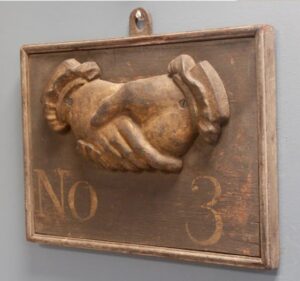
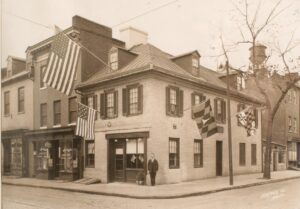
Mrs. Pickersgill’s flag was later known as the “Star Spangled Banner Flag” and is among the most treasured artifacts located at the Smithsonian’s National Museum of American History in Washington, D.C. The home of Mary Pickersgill was once insured by Baltimore Equitable: note the fire mark under the Baltimore City flag.
When Pickersgill was making the flag, the Company’s office was located just around the corner on Baltimore Street.
Sept 1814
Battle of North Point; Fort McHenry Bombarded
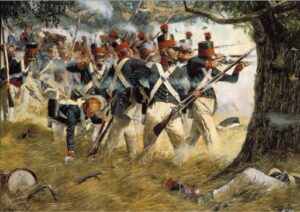
September 12, 1814 Brigadier General Stricker’s 3rd Brigade of the MD State Militia engaged the British Army and Navy in the Battle of North Point near the Patapsco River. This early engagement delayed the British troops and allowed time for the American militia to defend the east side of Baltimore from British advancement. British Major General Ross was mortally wounded.
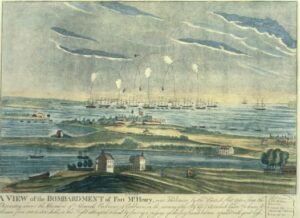
September 13-14, 1814 American troops stationed at Fort McHenry defended the Baltimore Harbor from attack by the British Navy. On the morning of September 14, the American flag made by Mary Pickersgill was raised over the fort. Francis Scott Key, a lawyer from Frederick, Maryland, who was on a ship in the harbor, saw the large flag waving in the “dawn’s early light” and was inspired to write the poem called “Defence of Fort McHenry”. This poem was later put to music and became America’s national anthem: “The Star Spangled Banner”.
Sept 18-19, 1814
Remains of British Soldiers Buried
Joseph Townsend, Baltimore Equitable Society’s Treasurer was outspoken on the then common practice of burying deceased indigents and unidentified corpses wherever they were found. Mr. Townsend had even raised the necessary funds amongst his friends to create a potter’s field in Baltimore (its location is under the current Johns Hopkins oncology center parking lot and garage). So, when it was determined that the remains of British casualties needed to be buried, Mr. Townsend was chosen to organize a group of men to bury the 44 unclaimed bodies.
1824
Marquis de Layfayette visits Baltimore and Joseph Townsend
In 1824, the Marquis de Layfayette who fought with the Americans during the Revolutionary War, made a return visit to America. Layfayette made a stop at the home of Joseph Townsend and presented him a gift of a desk. They discussed the Battle of Brandywine, as they both had been there many years earlier, and continued a correspondence afterwards.
Sept 30, 1841
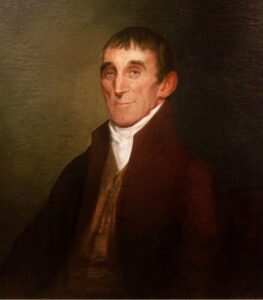
Joseph Townsend, Treasurer of Baltimore Equitable Dies
Joseph Townsend, Treasurer of Baltimore Equitable dies in his 85th year. Townsend served as Treasurer of Baltimore Equitable for over 47 years.
Joseph Townsend was born a Quaker in Chester County, PA on February 26, 1756. Townsend was married three times resulting in a total of 23 children but only nine lived to years of maturity.
In addition to founding Baltimore Equitable, Joseph Townsend was a member of the Board of Health (1794, 1797 & 1800), a Commissioner appointed to lay out the City of Baltimore, a founding member of Friends School of Baltimore, founder of the first anti-slavery society in Maryland, and held many other private, corporate and government roles.
Dec 1, 1841
Baltimore Equitable Society Moves their Office
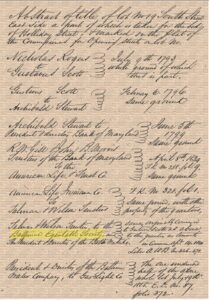
Upon the death of Joseph Townsend, the Baltimore Equitable could no longer operate their business from his home. The Company moved to 19 South Street, where they rented two rooms on the first floor from American Life Insurance & Trust Co. for $400 a year.
On May 29, 1851, Baltimore Equitable and The Baltimore Water Company jointly purchased 19 South Street.
In 1855, the Baltimore Water Co. sold their interest in 19 South St. to the Gas Light Company of Baltimore (now known as BGE).
Baltimore Equitable shared the building with the Gas Light Company of Baltimore until the building was sold in 1889. It is believed 19 South Street was severely damaged or destroyed during the Great Baltimore Fire of 1904. The Furness House, built in 1917, now stands in its place.
April 19, 1861
Baltimore Riot of 1861
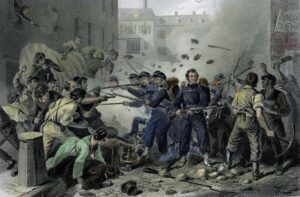
Southern/Confederate sympathizers attacked the Federal Militia while the militia was traveling from the President St Station to the Camden St station. The Federal Militia (primarily from the 6th Massachusetts) had just been called upon and was en route to Washington, D.C. Four soldiers and 12 civilians were killed in the riot. Since these were the first deaths (by hostile actions) in the Civil War, it was known as the “First Bloodshed of the Civil War”.
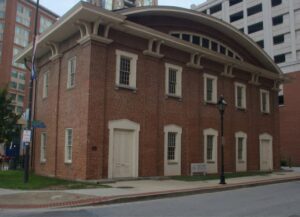
Baltimore Equitable’s offices were located just a few blocks away. When the Federal Militia fled from President Street Station, they may have passed the Company’s office windows.
March 1889
Baltimore Equitable Society Moves their Office for the 2nd Time
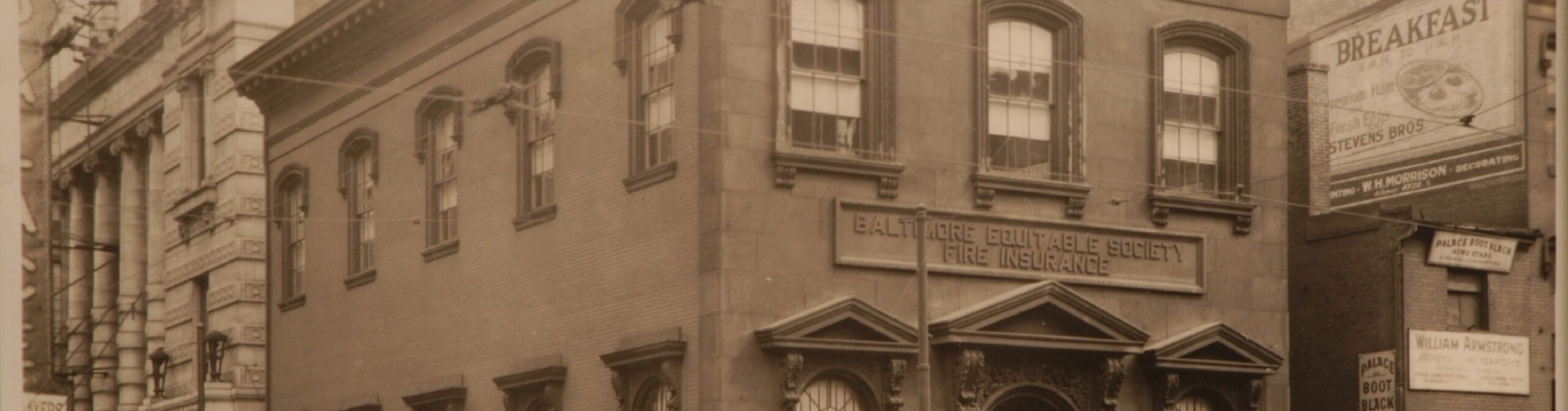
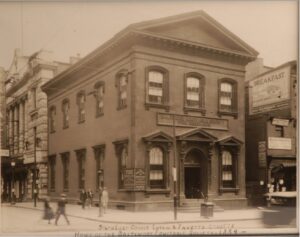
Baltimore Equitable purchased the Eutaw Savings Bank building located at the southeast corner of Eutaw and Fayette Streets (later addressed as 21 North Eutaw St) for $35,000 on March 6, 1889.
Eutaw Savings Bank had outgrown their building and relocated directly across the street. In 1989, the “new” Eutaw Savings Bank building was adjoined with the Western National Bank building and is now known as the Baltimore Grand.
The Company remained at 21 North Eutaw Street for 114 years until moving to an office suite located in 100 North Charles St.
Feb 7-8, 1904
The Great Baltimore Fire
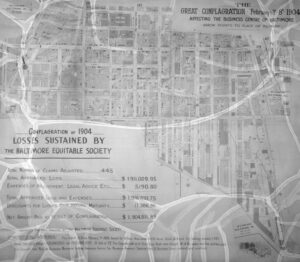
Fire raged in Baltimore for over 30 hours, fueled in part by strong winds, destroying over 80 blocks in the downtown area. More than 1,500 buildings were completely destroyed and another 1,000 damaged. Fortunately, no lives were lost. Fire companies were sent from Philadelphia & Washington D.C. to assist in extinguishing the fire, but since standardization for fire hose couplings did not exist, the fire companies were unable to hook up their equipment.
The fire began at the John Hurst & Company building on W German St, now known as Redwood Street. Baltimore Equitable sustained 445 claims and paid out over $1.9 million in losses (close to $55 million today). Despite the large amount of losses, the Company continued to operate while the city rebuilt.
Oct 1929
Stock Market Crashes – The Beginning of the Great Depression
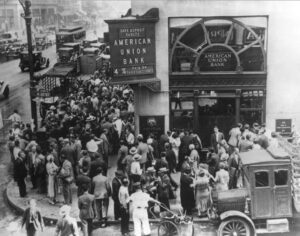
Stock prices began falling in September and early October of 1929 resulting in a mass panic of investors. On Black Tuesday, October 24, 1929, a record of 16 million shares were traded resulting in the collapse of share prices. Millions of shares ended up worthless and many investors wiped out.
By 1932, 15 million people, more than 20% of the U.S. population, were unemployed. Thousands of banks closed taking with them any money that individuals had deposited.
As a result of the Depression, protection for depositor’s accounts (FDIC) and stock market regulations (SEC) were put in place. The Social Security Act was also passed, providing Americans, for the first time, with unemployment, disability and pensions.
Baltimore Equitable continued to operate and survive the Great Depression. The Company’s surplus remained intact, investments remained secure and assets grew by 23%.
April 6-14, 1968
Baltimore Riot of 1968
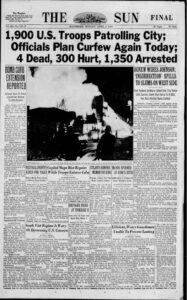
Across the nation, cities grieved the assassination of Dr. Martin Luther King, Jr. A peaceful gathering of approximately 300 people to memorialize the Civil Rights Leader lasted until 2pm without incident. Afterwards, a crowd formed on Gay St in East Baltimore and by 5pm reports of vandalism & fires were received, marking the beginning of the Baltimore Riot. A state of emergency was declared.
By April 7, federal troops were requested after it was determined the National Guard and police force were unable to contain the uprising. The riot ended on April 14 resulting in 6 deaths, 700 injured, 5,800 arrested and 1,000 businesses damaged. Total property damage was assessed at $12 million (equivalent to $77.5 million today).
After the unrest, some insurance companies refused to cover properties located inside the city limits, but Baltimore Equitable continued to insure homes throughout Maryland, including Baltimore City.
1988
Baltimore Equitable Insurance
Baltimore Equitable Society begins trading as Baltimore Equitable Insurance because even though the Company is now almost 200 years old, most people did not even know who or what the company did. People thought the Company was some form of a social or ‘brotherhood” organization. While the legal name remains Baltimore Equitable Society for Insuring Houses from Loss by Fire or shortened (for IRS purposes) Baltimore Equitable Society, it is now better known as Baltimore Equitable Insurance.
Sept 2003
Hurricane Isabel Strikes Maryland While Baltimore Equitable Moves their Office
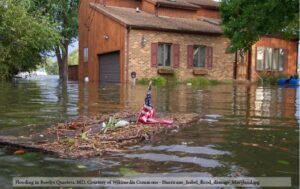
Hurricane Isabel: Hurricane Isabel slammed into Maryland, causing $2 billion in damages, two fatalities and over 300 buildings were destroyed by coastal flooding. Wind gusts of 53mph were recorded in Baltimore and 83mph in Silver Spring. The tide gauge from the Patapsco River at Fort McHenry reached a new record of 8.15 feet. Streets in Fell’s Point and the Inner Harbor were completely flooded. Baltimore Equitable paid a total of $708,576 in losses.
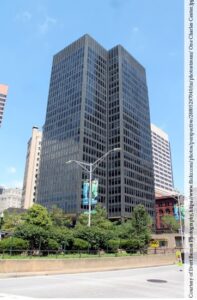
Baltimore Equitable Moves: Due to major renovations needed at the Company’s 21 N. Eutaw St. location, Baltimore Equitable decided to relocate to 100 N. Charles St. Occupying the space for 114 years, along with the Company’s museum on the 2nd floor, resulted in a large packing effort. Many items were donated to the Maryland Historical Society, The Museum of Industry, and The Fire Museum of Maryland. When the moving vans arrived, so did Hurricane Isabel. Baltimore Equitable’s dedicated staff worked tirelessly through the weekend in order to be prepared to be there for policyholders in their time of need.
Sept 29, 2008
DOW falls over 777 points
The Dow Jones falls over 777 points because Congress rejected the bank bail-out bill. Baltimore Equitable Insurance’s, like many other companies’, portfolio value decreased, but this decrease did not affect the servicing of our clients, the operation of our business, or the protection of the policyholders’ deposits in any way. Baltimore Equitable Insurance’s portfolio fully recovered to its former valuation by December 2010, due in part to its careful, well managed investments in stable companies.
Feb 17, 2019
Baltimore Equitable Celebrates 225 Years
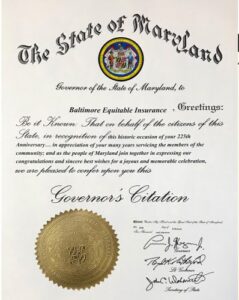
In 2019, to recognize their achievement of reaching 225 years, Baltimore Equitable was presented with a Mayoral Salute from the City of Baltimore and a Governor’s Citation from the State of Maryland.
Baltimore Equitable is proud to be the second oldest insurance company in the United States, and the oldest operating business in Baltimore City: even older than the City itself.
Despite the conflicts and economic crises throughout the city and nation during the last 225 years, Baltimore Equitable continues to grow stronger and is committed to providing perpetual insurance to customers in Maryland and Pennsylvania for years to come.
October 2023
Baltimore Equitable Moves to Harbor East
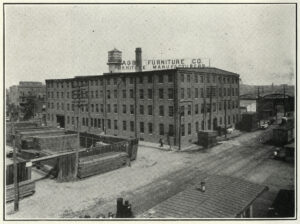
Now located in the historic Bagby Furniture Company Building at 509 S. Exeter St., Baltimore Equitable Insurance sits within the Harbor East neighborhood of Baltimore, known for its mix of businesses, restaurants, and retail. The Bagby Furniture Company operated from 1879 to 1990, and the building was added to the National Register of Historic Places in 1998.

Get to Know Our Team

Jason Coben
Joe Bilder
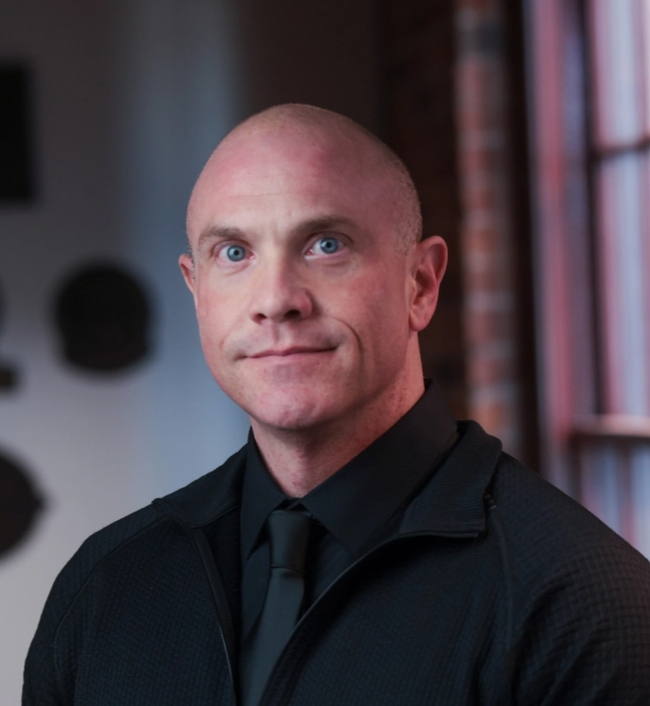
James Knauer

Jeffrey Wrobel

Dorren Willis
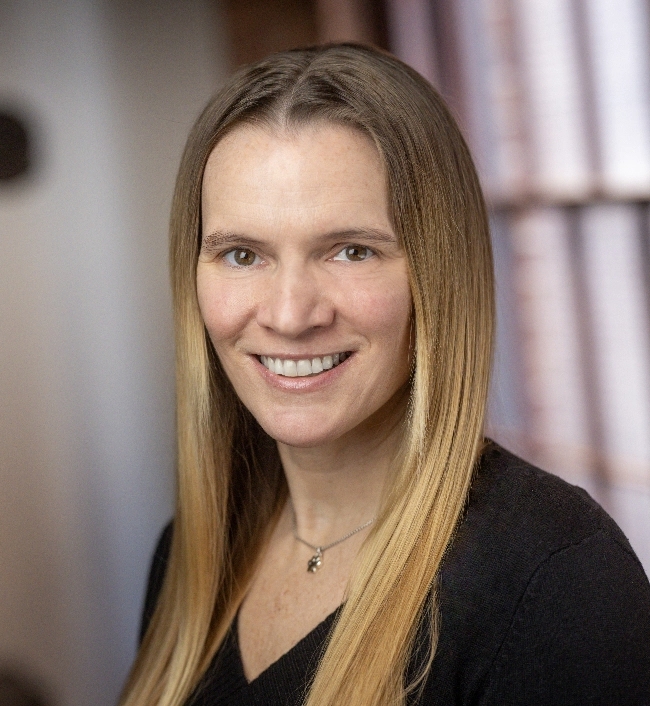
Shannon Pirrung
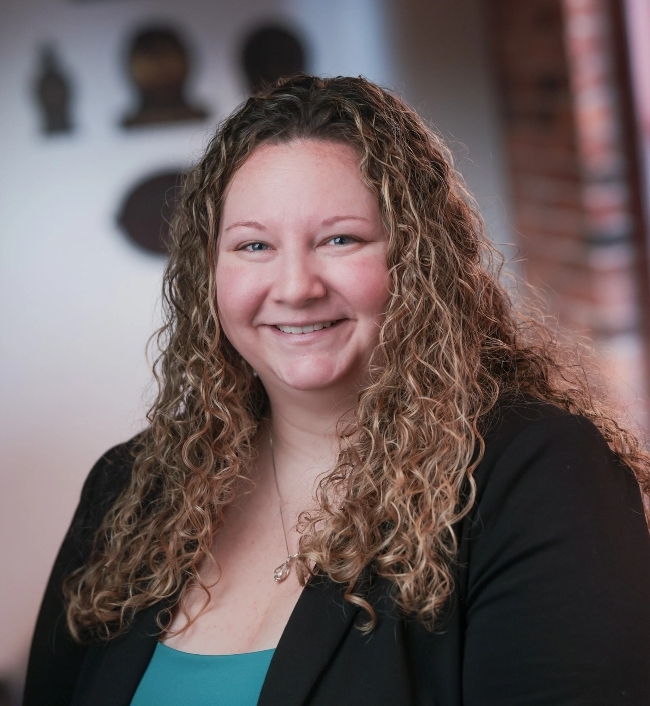
Taylor Kraft
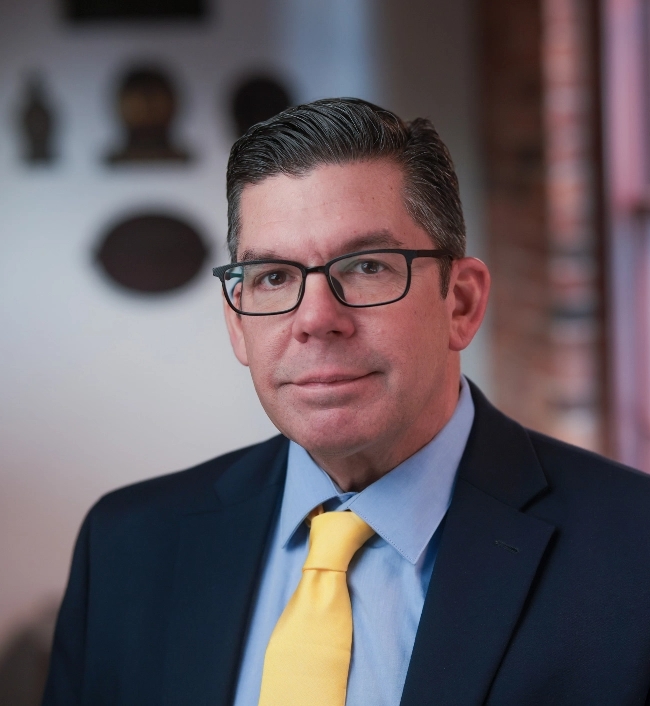
Caesar Rossilli
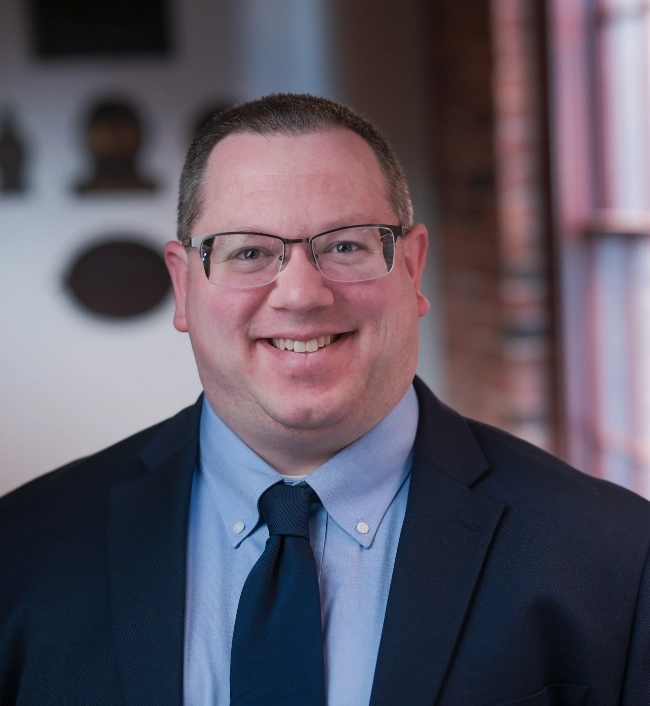
Rob Kraft
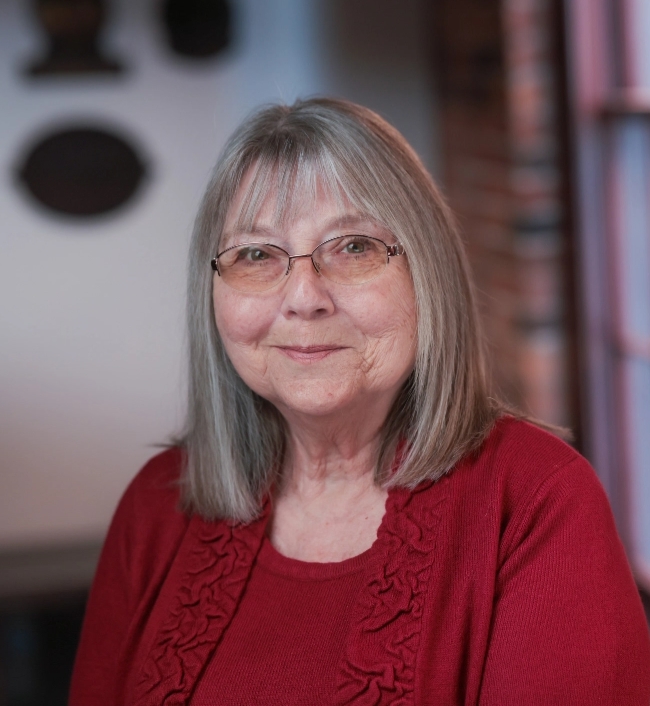
Kathy Aull
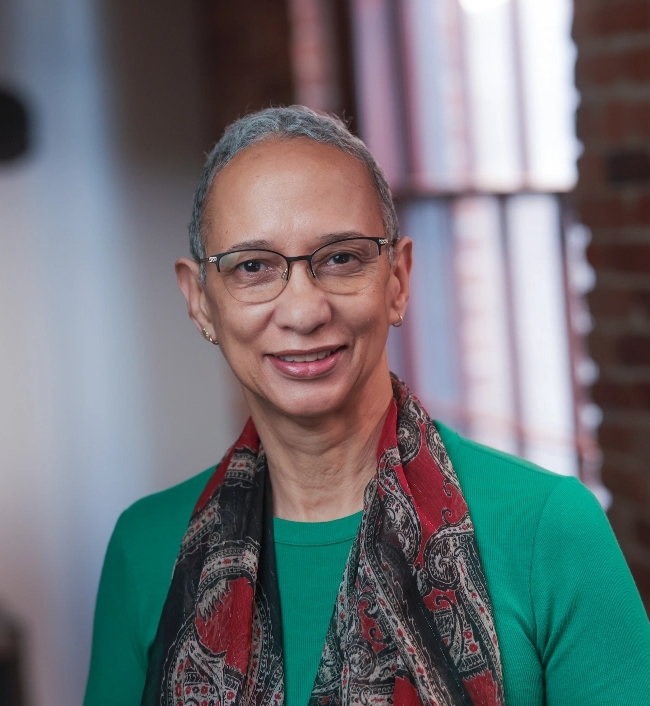
Lillian Lansey
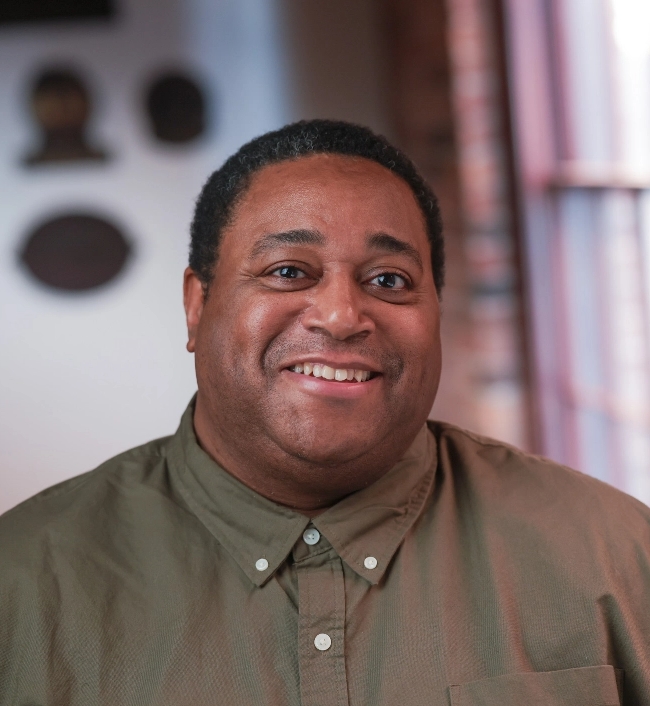
Paul Williams

Brandi Hogan-Northcutt
Meet the Members of the Board
John D. Linehan, CFA
Portfolio Manager and Chief Investment Officer, Equity – T. Rowe Price
Sheryl Goldstein
Founder & CEO, Pluck, LLC
Frances L. Cashman
Independent Director, former CEO
Euromoney PLC Asset Management
Robert G. Whitlock, Jr., FCAS
Retired President and CEO of The Philadelphia Contributionship
Marjorie Rodgers Cheshire
Principal & Co-Owner
A&R Development
Steven D. Linkous
Tedd M. Alexander III
VP Head of Global Integrated Equity
David W. Kinkopf
Executive Director, Catholic Charities of Baltimore
Former Partner, Gallagher LLP
John Berndt
SVP, Valtech Health, The Americas